Water has always been one of West Maui's most valuable resources. From the streams flowing through the West Maui Mountains to the groundwater aquifers supporting our communities, access to reliable water shapes everything from agriculture and environmental stewardship to housing development and property values.
In 2026, several significant developments are reshaping how West Maui's water resources are managed. Maui County is pursuing public ownership of privately operated water systems, new wells and infrastructure improvements are moving forward, and the State of Hawaiʻi continues reviewing water use permits across the Lahaina region.
For homeowners, buyers, investors, and those considering building in West Maui, these changes are worth understanding.
Here's a look at the latest developments and what they could mean for West Maui real estate.
Maui County Moves Toward Public Ownership of West Maui Water Systems
One of the most significant developments of 2026 is Maui County's effort to acquire several privately owned water systems.
In May, the County announced a memorandum of understanding with Maui Land & Pineapple Company (MLP), establishing a framework for acquiring the company's West Maui water infrastructure.
The broader initiative includes negotiations involving water assets in Olowalu, Launiupoko, and the Honokōhau Ditch system.
According to Maui County, the proposed acquisitions could increase public stewardship of West Maui's drinking water systems from approximately 45% to 93%.
CURRENT PUBLIC STEWARDSHIP 45% Of drinking water systems | PROPOSED PUBLIC STEWARDSHIP 93% If planned acquisitions are completed |
This represents a potentially substantial change in how West Maui's water infrastructure is owned and managed.
Historically, portions of West Maui have relied on private water companies and infrastructure associated with former agricultural lands and resort developments. Bringing more of these systems under public ownership could improve coordination of infrastructure investment, emergency preparedness, and long-term water planning.
However, the proposed transactions are not the same as completed acquisitions. Final agreements, funding, regulatory approvals, and operational transitions remain important steps.
For property owners, the significance extends beyond who owns the water infrastructure. It raises questions about future service reliability, capital improvements, water rates, and the availability of water for new development.
Source: Maui County, May 18, 2026.
New November 2026 Agreement Could Shape Launiupoko's Water Future
Another important development was announced November 2, 2026.
Maui County and Kamehameha Schools are proposing an agreement to coordinate stewardship and potential transfers of important West Maui water resources.
The arrangement follows Kamehameha Schools' 2025 acquisition of nearly 4,000 acres in the Lahaina area, which included an option to purchase the Launiupoko Irrigation Company system.
Under the proposed agreement, Kamehameha Schools would assume responsibility for the Kauaʻula surface water systems, including continued service to kuleana landowners. The arrangement also includes conditional water source credits for future needs on Kamehameha Schools' Kuʻia lands.
The agreement still requires Maui County Council and regulatory approvals.
Why this matters for Launiupoko property owners: Water in this area is particularly complex because some properties depend on private potable water systems, agricultural irrigation systems, or separate arrangements for different uses.
A change in ownership or management does not automatically change an individual property's water entitlements or service agreements. Buyers should continue verifying the specific water sources, meter arrangements, and service obligations associated with each property.
Source: Hawaiʻi Public Radio, November 2, 2026.
New Wells and Infrastructure Improvements Are Moving Forward
While ownership changes are attracting attention, expanding the actual water supply is equally important.
Maui County has identified several major infrastructure projects intended to improve reliability and support Lahaina's recovery.
These include:
- Four new well fields: Two in the Launiupoko aquifer and two in the Honolua aquifer, intended to increase water supply for the Lahaina area.
- Honokōwai Tunnel project: A proposed groundwater collection and transmission system designed to diversify potable water sources.
- Mahinahina Water Treatment Plant: Planned improvements to strengthen West Maui's water supply infrastructure.
- Lahaina water storage and pipelines: A proposed 1.7-million-gallon storage tank, replacement of undersized waterlines, and transmission improvements to increase water flow and firefighting capacity.
In the County's 2026 State of the County Address, Mayor Richard Bissen outlined water infrastructure improvements that, collectively, could provide capacity for up to 3,500 additional housing units.
That figure represents planned infrastructure capacity, not 3,500 approved homes or immediately available water meters.
The County's recovery project documentation also identifies permitting, environmental reviews, funding, and water allocation decisions as dependencies for several projects.
These improvements are especially important following the 2023 Lahaina wildfire, which highlighted the need for resilient water infrastructure, adequate storage, and dependable firefighting capacity.
Sources: Maui County 2026 State of the County Address and Office of Recovery project updates.
West Maui's Water Supply Remains Constrained
Despite these investments, water availability remains an important consideration for new development.
In November 2025, Maui County released a Maximum Reliable Capacity analysis of its West Maui water system, which serves the Nāpili and Lahaina areas.
The study found that projected demand for 2027 could exceed the system's reliable capacity by approximately 41.8%.
The County identified the Kahana Well as an important additional groundwater source, expected to produce approximately 960,000 gallons per day. Even with that additional capacity, the study projected demand would remain 15.7% above reliable supply.
Projected 2027 demand compared with reliable water capacity
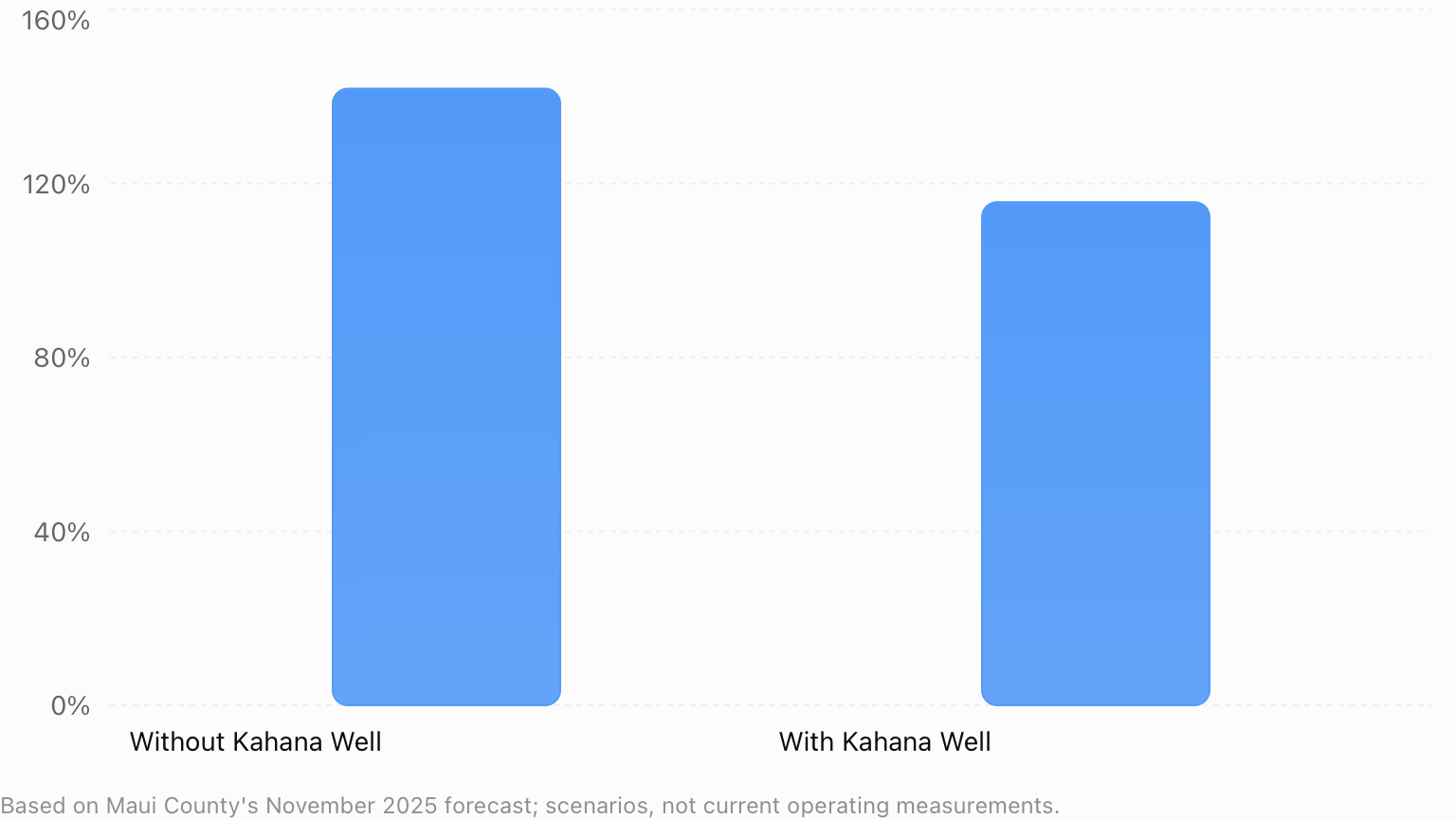
Based on Maui County's November 2025 forecast; scenarios, not current operating measurements.
The analysis underscored the importance of developing additional water sources before accommodating further demand.
Although the Kahana Well was anticipated to become operational in early 2026, we have not confirmed its current operational or permitting status as of this November update.
For those considering vacant land purchases, subdivisions, or new construction, water availability should be investigated early in the due diligence process. A property being zoned for residential use does not necessarily mean additional water service is immediately available.
Source: Maui County Department of Water Supply, November 17, 2025.
State Water Regulation: Important Changes for West Maui
Another development is the ongoing implementation of the Lahaina Surface and Ground Water Management Area designation.
The designation places water withdrawals within the affected area under a state-managed permitting framework overseen by the Hawaiʻi Commission on Water Resource Management.
The process involves evaluating water use applications and balancing competing demands, including:
- Residential and municipal water needs
- Agriculture and irrigation
- Traditional and customary Native Hawaiian practices
- Stream restoration and environmental protection
- Commercial and resort uses
On October 15, 2026, the Commission published another round of water use permit applications covering several West Maui aquifers and streams, including Honolua, Honokōwai, Honokōhau, Launiupoko, and Olowalu.
The deadline for objections to this round is November 6, 2026.
Importantly, an application for water use is not the same as an approved allocation. The permitting process may influence future access to water, particularly for properties relying on private wells, surface water diversions, or agricultural irrigation systems.
For owners of larger acreage properties and undeveloped land, understanding the source and legal status of water access is becoming increasingly important.
Source: Hawaiʻi Commission on Water Resource Management, October 2026.
What These Changes Mean for West Maui Real Estate
Water infrastructure and access are not always visible features of a property, but they can be important factors in determining its long-term utility and development potential.
For buyers considering West Maui property, several questions deserve attention.
Existing homes and condominiums: Confirm the water provider, service arrangements, and any known supply limitations. For resort communities and condominium associations, irrigation water and domestic water may come from different sources.
Vacant land and new construction: Verify whether a water meter exists, whether additional service is available, and whether proposed development will require additional approvals or allocations.
Agricultural and estate properties: Understand the distinction between potable and non-potable water. Irrigation service does not necessarily authorize residential use, and water rights or service agreements may carry specific limitations.
Kapalua and Kaanapali properties: Changes involving Maui Land & Pineapple and the Honokōhau Ditch system could influence long-term infrastructure management. However, buyers should not assume that proposed public acquisitions automatically increase water availability or alter existing service agreements.
Lahaina redevelopment: Water supply, storage, and firefighting capacity will remain essential components of rebuilding and supporting future housing.
Looking Ahead: Water Security and West Maui's Future
West Maui is entering an important period of transition in water management.
The County's proposed acquisitions, new groundwater projects, infrastructure investments, and state regulatory oversight represent substantial efforts to address challenges that have developed over decades.
Yet the distinction between planned improvements and available water remains important.
As real estate advisors working throughout West Maui, we view water access as an essential part of evaluating property, particularly when considering land acquisitions, redevelopment opportunities, and long-term ownership.
Understanding not only a property's location and physical characteristics, but also its infrastructure and resource access, can help buyers make more informed decisions.
West Maui's future depends on balancing community needs, cultural and environmental stewardship, wildfire recovery, and responsible development. Reliable water resources will be central to all of them.
Pacific Island Partners specializes in West Maui real estate, including Kaanapali, Kapalua, Lahaina, and surrounding communities. Whether you are considering purchasing land, investing in property, or evaluating an existing asset, our team provides local market knowledge and property-specific guidance to help you navigate the complexities of ownership in Hawaii.