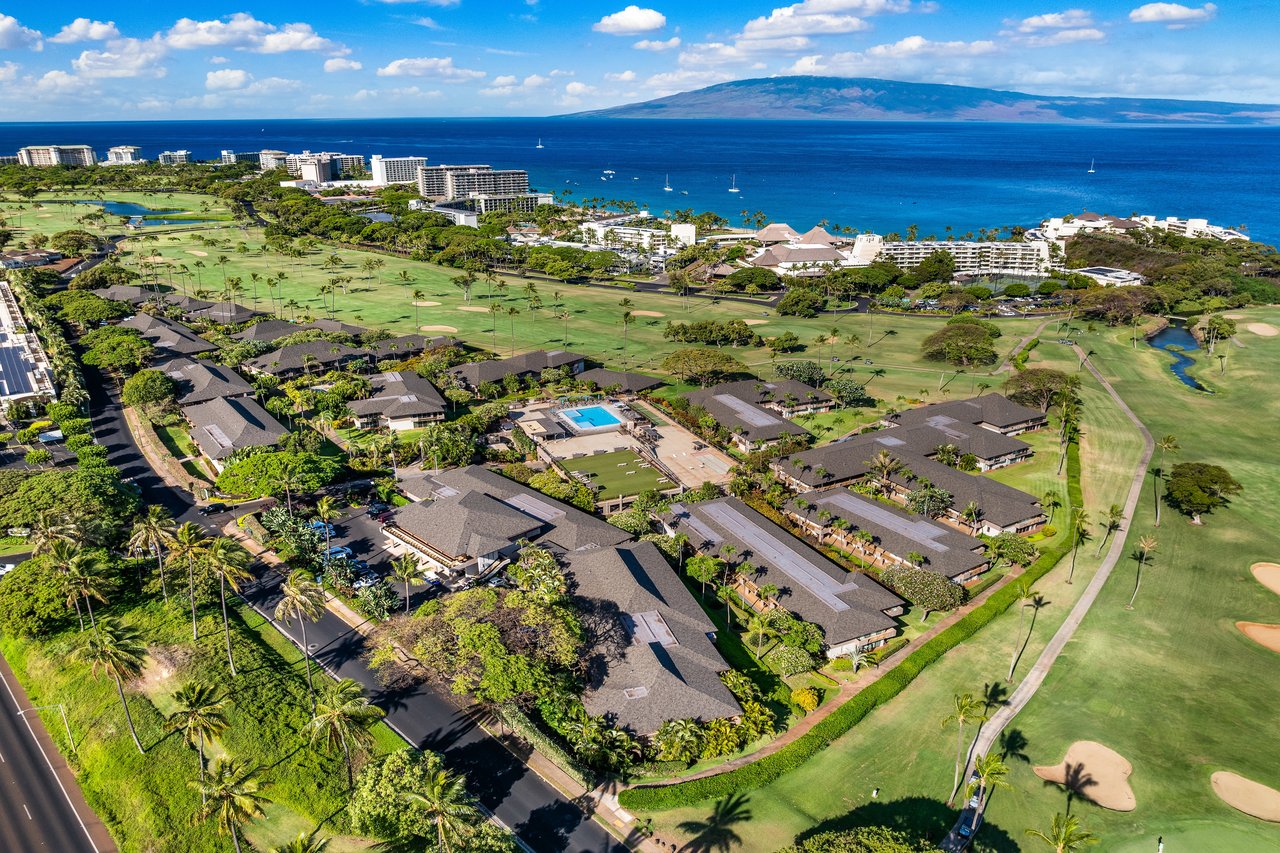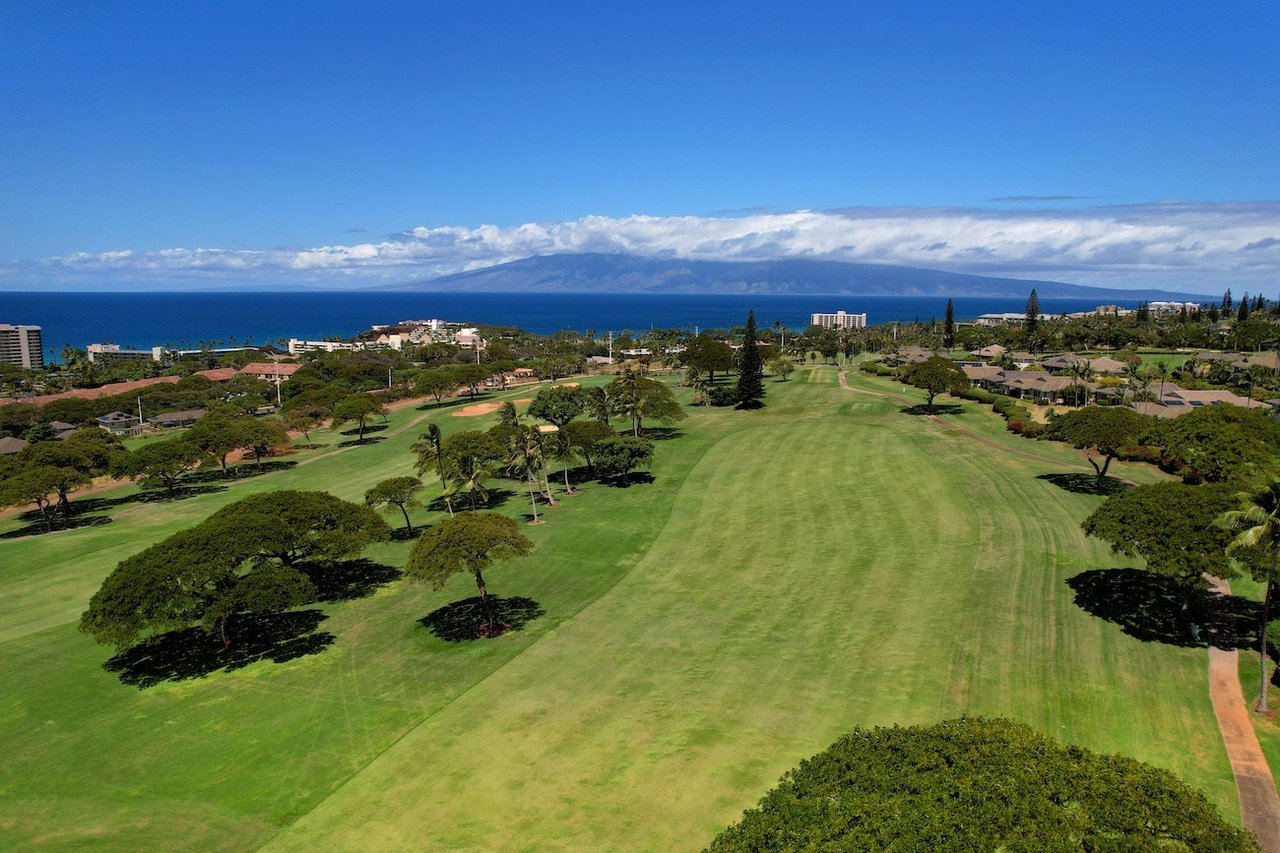
Inheriting property in Hawaii is rarely as simple as people expect. Many heirs arrive with the quiet assumption that land and homes pass automatically to the closest family member, only to discover that state law has its own deliberate, sometimes surprising order of priority. Hawaii’s inheritance framework is shaped by a distinct legal code, cultural traditions of stewardship, and real estate conditions unlike anywhere else in the country. Whether you’ve recently lost a loved one or are planning ahead, understanding how Hawaii actually handles property inheritance can save you months of uncertainty and protect the legacy you’ve been entrusted to carry forward.
Table of Contents
- How property inheritance works in Hawaii: The legal foundation
- Who inherits property in Hawaii? Understanding intestate succession
- Navigating probate in Hawaii: What heirs should expect
- Spouse and heir rights: Elective shares, homestead, and special rules
- Taxes, real property, and unique Hawaii considerations
- Our perspective: What most guides miss about Hawaii inheritance
- Expert help for Hawaii inheritance and real estate transfers
- Frequently asked questions
Key Takeaways
| Point | Details |
|---|---|
| Hawaii’s inheritance laws are unique | Hawaii follows its version of the Uniform Probate Code, making inheritance rules distinct from other states. |
| Spouses receive special protections | The law provides elective shares and allowances so surviving spouses are safeguarded, even without a will. |
| Probate is often unavoidable | Most Hawaii property transfers go through probate, which usually takes 6–12 months. |
| Estate tax only for large estates | No Hawaii inheritance tax exists, and the estate tax only applies to estates over $5.49 million. |
| Expert help prevents costly errors | Navigating Hawaii inheritance is easier with guidance due to state-specific rules and deadlines. |
How property inheritance works in Hawaii: The legal foundation
Hawaii’s approach to inheritance is grounded in a single, governing statute. The state governs property inheritance under HRS Chapter 560, known as the Uniform Probate Code, which covers heirship, wills, intestate succession, and the probate process. This framework gives Hawaii a relatively modern, structured system, but it still carries nuances that catch many heirs off guard.
At its core, there are two legal paths for property to transfer after death. The first is testate inheritance, meaning the deceased left a valid will. The second is intestate inheritance, meaning no will exists and state law decides who receives what. These are not interchangeable. A will gives the deceased significant control over distribution; intestate succession follows a fixed legal hierarchy regardless of personal wishes.
Who qualifies as an heir or beneficiary matters enormously. Under HRS Chapter 560, heirs are those entitled by law to inherit when no will exists, while beneficiaries are those named in a will or trust. The distinction shapes every step of the process.
One rule that surprises many families is the 120-hour survivorship requirement. Under Hawaii law, a person must survive the deceased by at least 120 hours (five full days) to inherit. This rule exists to prevent property from passing twice in rapid succession when two people die close together, such as in an accident. If the heir does not survive that window, they are treated as having predeceased the original owner.
| Inheritance path | Requires a will? | Who decides distribution? | Typical timeline |
|---|---|---|---|
| Testate (with will) | Yes | Deceased, via will | 6 to 12 months |
| Intestate (no will) | No | Hawaii state law | 6 to 18 months |
| Trust-based transfer | No (bypasses probate) | Trustee per trust terms | Weeks to months |
“Hawaii’s Uniform Probate Code creates a clear but layered system. Knowing which path applies to your situation is the first, most critical step.”
Understanding this foundation gives you the footing to navigate everything that follows with greater confidence and clarity.
Who inherits property in Hawaii? Understanding intestate succession
Now that the legal framework is clear, let’s get practical: if there’s no will, who actually inherits property in Hawaii?
Intestate means dying without a legally valid will. In that case, Hawaii’s intestate succession rules determine exactly who receives what, and the results don’t always match what families assume. The law follows a priority order: surviving spouse first, then descendants (children and grandchildren), then parents, then siblings, then grandparents, and finally more distant relatives.
The spouse’s share depends heavily on family structure:
-
No descendants or parents surviving: The spouse inherits the entire estate.
-
Descendants from a prior relationship exist: The spouse receives the first $100,000 plus one-half of the remaining balance.
-
Parents survive but no children: The spouse receives the first $400,000 plus three-quarters of the balance.
-
Descendants shared with the surviving spouse: The spouse inherits the entire estate.
These formulas exist to balance the competing interests of a blended family, and they can produce outcomes that feel counterintuitive. A spouse in a second marriage, for example, may receive far less than expected if children from a prior relationship are involved.
| Family situation | Spouse receives | Children/others receive |
|---|---|---|
| Spouse only, no children or parents | Entire estate | Nothing |
| Spouse and children (all shared) | Entire estate | Nothing |
| Spouse and children from prior relationship | $100k + 1/2 balance | Remaining balance |
| Spouse and parents, no children | $400k + 3/4 balance | Parents share remainder |
| No spouse | Nothing | Descendants inherit all |
One often-overlooked protection involves pretermitted heirs, sometimes called omitted children. If a child was born or legally adopted after a will was executed and was not included, Hawaii law may still grant them a share of the estate. This applies even when a will exists, making it a critical edge case for blended or growing families.
Pro Tip: Don’t assume that a surviving spouse automatically inherits everything. In Hawaii, the family structure at the time of death determines the actual distribution, and even a small detail like a child from a previous relationship can significantly shift the outcome.
Navigating probate in Hawaii: What heirs should expect
Knowing who inherits is only the first step. Actually claiming inherited property often means going through Hawaii probate.
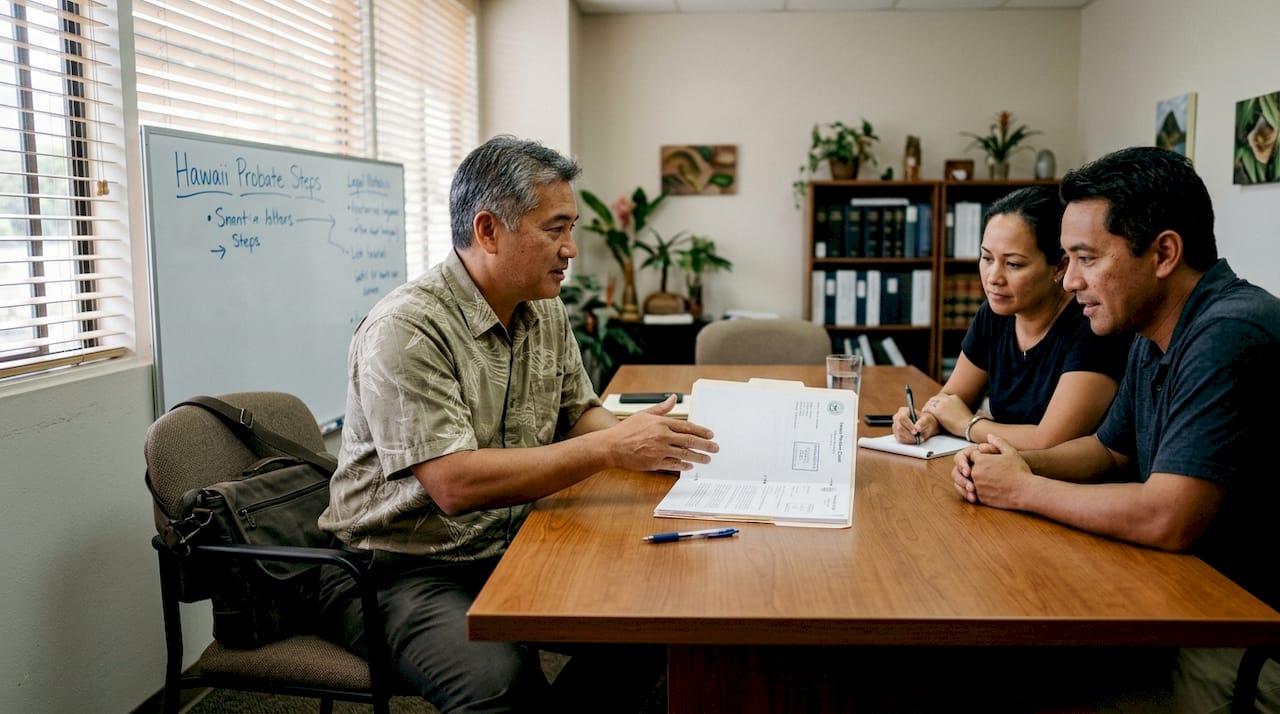
Probate is the court-supervised process used to validate a will, settle debts and taxes, and distribute assets to rightful heirs. In Hawaii, probate typically takes 6 to 12 months, though contested cases or complex estates can stretch well beyond that. The process applies whether or not a will exists.
Here is how the process generally unfolds:
-
File a petition with the Hawaii Circuit Court in the county where the deceased lived.
-
Appoint a personal representative (executor) to manage the estate.
-
Notify creditors and heirs as required by law, typically within a set window after filing.
-
Inventory and appraise assets, including all real property, accounts, and personal belongings.
-
Pay valid debts, taxes, and administrative costs from estate assets.
-
Distribute remaining assets to heirs or beneficiaries per the will or state law.
-
Close the estate by filing a final accounting with the court.
The court’s role is significant. It validates the will’s authenticity, oversees the personal representative, and protects creditors and heirs alike. If disputes arise, such as a contested will or a disagreement among heirs, the timeline and costs can expand considerably. Understanding Hawaii probate tax issues early in the process helps avoid costly surprises at the distribution stage.
“Probate is not a punishment. It is a structured safeguard, designed to ensure that debts are honored and assets reach the right people.”
Pro Tip: Gather all key documents before filing, including the original will, death certificate, property deeds, and financial account statements. Having these ready from the start can shave weeks off the process and reduce legal fees significantly.
Heirs also need to watch specific deadlines. The window to claim an elective share or contest a will is limited, and missing it can forfeit rights that cannot be recovered.
Spouse and heir rights: Elective shares, homestead, and special rules
Beyond basic inheritance order, Hawaii law gives extra rights and safeguards to spouses and certain heirs.
The most powerful of these is the elective share. A surviving spouse may claim up to 50% of the augmented estate, regardless of what the will says. The augmented estate includes not just probate assets but also certain transfers made during the deceased’s lifetime. This protection exists so a spouse cannot be entirely disinherited. The deadline to claim the elective share is 9 months from the date of death, and missing it means losing the right entirely.
Additional protections include:
-
Homestead allowance: A surviving spouse (or minor children if no spouse survives) is entitled to a $30,000 homestead allowance from the estate, separate from the elective share.
-
Family allowance: A reasonable allowance may be granted to support the spouse and dependent children during the probate process.
-
Exempt property: Certain household items and personal property may be set aside for the spouse before general creditors are paid.
-
120-hour survivorship rule: As noted earlier, an heir must survive the deceased by five full days to inherit.
Problems often arise with pretermitted (omitted) heirs, particularly children born after a will was written. Hawaii law may grant them a share even if the will predates their birth or adoption, which can disrupt carefully laid estate plans.
Pro Tip: If you are a surviving spouse, act quickly. The 9-month deadline for the elective share is firm, and many families lose this benefit simply because they didn’t know it existed or assumed it was handled automatically.
Taxes, real property, and unique Hawaii considerations
Once inheritance rights are secure, it’s key to understand the tax and real property consequences of inheriting in Hawaii.
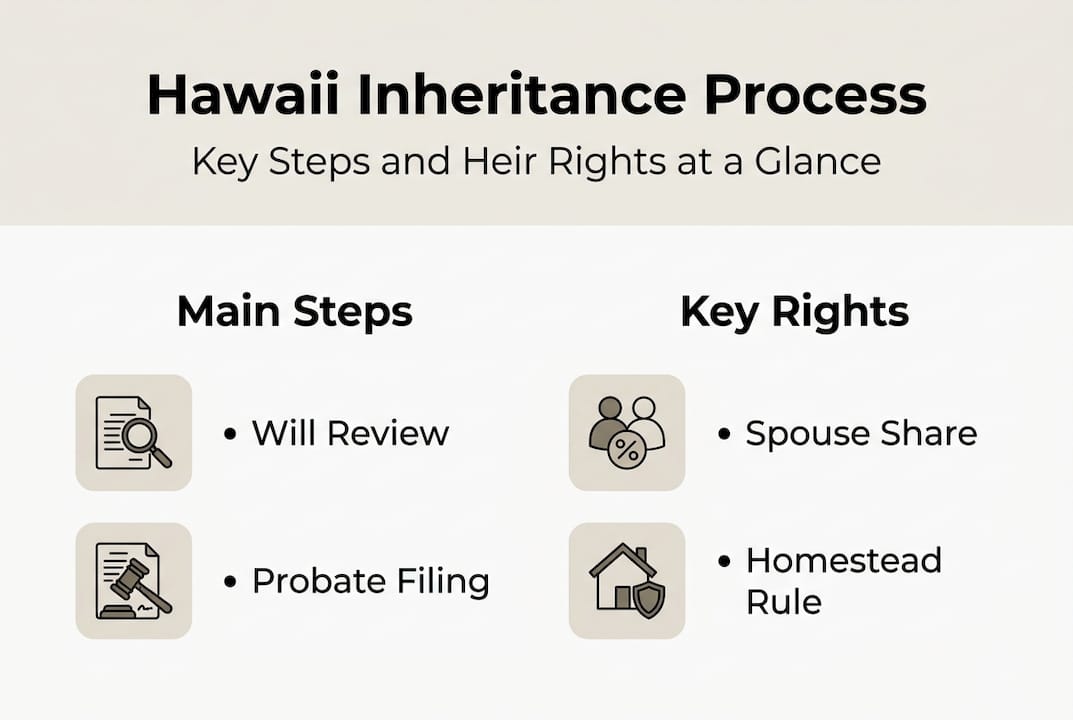
Here is the good news: Hawaii has no state inheritance tax. You will not owe taxes simply because you received property. However, Hawaii does impose an estate tax on estates exceeding $5.49 million as of 2026. Estates below that threshold owe nothing at the state level. Federal estate tax may still apply for very large estates, so heirs of significant holdings should consult a tax professional.
One of the most valuable tax advantages for heirs is the step-up in basis. When you inherit property, its cost basis is reset to the fair market value at the date of death. This means if you sell the property shortly after inheriting it, you may owe little or no capital gains tax, even if the original owner held it for decades and it appreciated significantly.
For real estate specifically, heirs should be aware of:
-
HARPTA and FIRPTA: These withholding rules apply when selling inherited Hawaii real estate, particularly for non-resident sellers. Understanding HARPTA and FIRPTA obligations before listing a property can prevent unexpected withholding at closing.
-
Title transfer requirements: Inherited property must go through a formal title transfer process, even after probate concludes.
-
Property tax reassessment: Inheriting a home may trigger a reassessment of property taxes depending on how the transfer is structured.
-
Market timing: Hawaii’s real estate market, particularly for beachfront and oceanfront properties, moves in ways that reward patient, informed decision-making.
The combination of no inheritance tax, a favorable step-up in basis, and Hawaii’s enduring property values makes inherited real estate here a genuine opportunity, if handled with care and proper guidance.
Our perspective: What most guides miss about Hawaii inheritance
Most inheritance guides stop at the law. What they rarely address is the human reality of navigating these rules while grieving, often from thousands of miles away.
Out-of-state heirs, in particular, are frequently caught off guard. They assume Hawaii operates like their home state. It does not. The 120-hour survivorship rule, the elective share deadline, and the specific intestate formulas for blended families are not common knowledge, and missing even one of them can cost a family dearly.
What we’ve seen firsthand, working with families across Maui and the surrounding islands, is that the biggest losses aren’t from bad intentions. They come from delay. A missed 9-month window for the elective share. A property sitting in limbo during probate while the market shifts. An heir who didn’t realize that HARPTA withholding would apply to their sale.
Even when a will exists, Hawaii’s real estate landscape rewards those who move with purpose and local knowledge. A well-prepared heir, guided by people who understand both the law and the land, can honor a loved one’s legacy while making sound decisions for the future. That is the kind of stewardship this place deserves.
Expert help for Hawaii inheritance and real estate transfers
Inheriting property in Hawaii carries both weight and possibility. The laws are navigable, but the details matter deeply, and the stakes are real.
This article is provided for general informational purposes only and is intended as a helpful resource. It does not constitute legal, financial, or tax advice. Readers should consult with qualified professionals to obtain advice specific to their individual circumstances.

At Pacific Island Partners, Heidi Dollinger and Mark Janes help families and heirs move through the complexity of Hawaii real estate with clarity and discretion. Whether you’re considering selling an inherited property, understanding your options as a new buyer in Hawaii, or exploring estates in areas like Kapalua, the team brings the local expertise and quiet confidence that this kind of decision deserves. Reach out to Pacific Island Partners for a confidential conversation about your specific situation.
Frequently asked questions
How long does Hawaii probate typically take?
Probate in Hawaii usually takes 6 to 12 months, but disputes among heirs or a contested will can extend the timeline significantly beyond that.
Is there an inheritance tax in Hawaii?
No. Hawaii has no inheritance tax, but the state does impose an estate tax on estates exceeding $5.49 million, and federal estate tax rules may also apply for larger estates.
Who inherits if there is no will in Hawaii?
The surviving spouse typically inherits the largest share, but children, parents, siblings, or other relatives may receive portions depending on the specific family situation at the time of death.
What is the elective share for a surviving spouse in Hawaii?
A surviving spouse may claim up to 50% of the augmented estate and must do so within 9 months of the date of death or the right is permanently lost.
Are stepchildren or adopted children treated the same as biological children for inheritance?
Adopted children generally inherit as biological children do under Hawaii law, but stepchildren who were never legally adopted do not carry the same automatic inheritance rights.