Maui County's real property tax rates for fiscal year commencing July 1, 2026 and running through June 30, 2027 have been approved by the Maui County Council.
Maui County's FY 2026–2027 tax structure shifts more of the tax burden toward non-owner-occupied properties, vacation rentals, and commercial residential uses, while providing modest relief for owner-occupied and long-term rental properties.
Property is classified based on its highest and best use. Properties receiving home exemptions, long-term rental exemptions, permitted bed and breakfasts and permitted transient vacation rental homes are exceptions. Condominiums are classified upon consideration of their actual use — Non-owner-occupied, Commercial, Short-term/Vacation rental, Long-term rental (rentals for 12 months or longer), Timeshare, or Owner-occupied. To receive the Owner-occupied and Long-term rental tax rates, owners need to fill out and file the appropriate forms with Maui County.
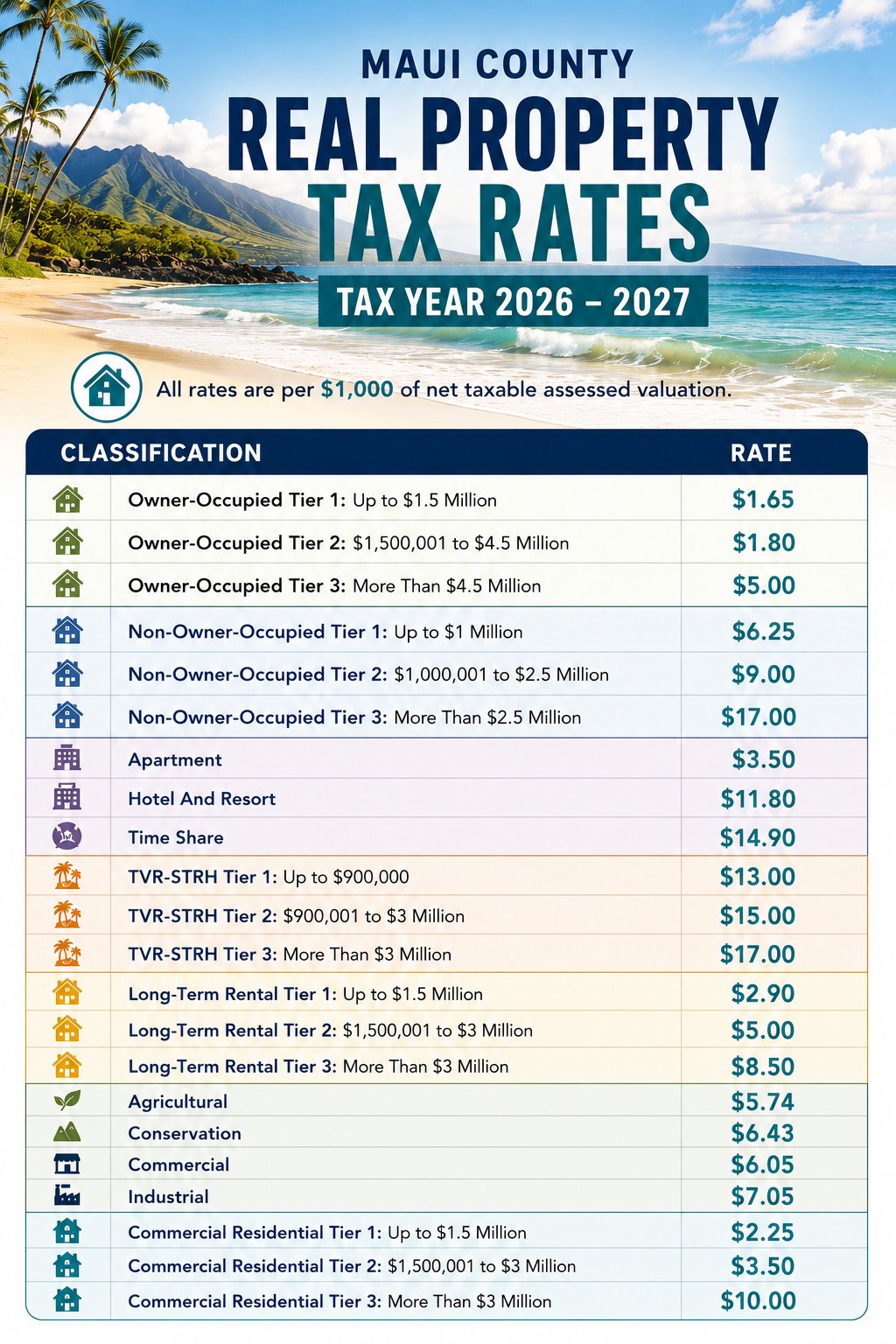
Compared to last year, the rate for Tier 3 for Owner-Occupied properties was reduced by 13%. Even so, the rate jumps up considerably for properties with assessed values of over $4.5M. There was no change for Tier 1 & 2. For owner-occupants, Maui County has some of the lowest property taxes in the United States.
The Long-term rental tax rate for Tier 1 decreased slightly and the threshold was expanded from $1.3mil to $1.5mil.
For Non-owner occupied properties, the tax rates increased 6.5% for Tier 1 and 4.7% for Tier 2 compared to last year.
Short-term rental rates for Tier 1 (up to $900k) increased by 4%, Tier 2 ($900,001 - $3M), increased by 7.1%, and Tier 3 (over $3M), increased by 9.3%.
Maui County Property Tax - Dates to Remember
July 1—Tax year commences. Taxes are calculated based upon January 1 assessed values and fiscal year tax rates.
July 20 — First half of fiscal year tax bills mailed.
August 20 — First half of fiscal year tax payments due.
September 1 — Deadline for filing dedication petitions.
December 1 — Condominium AOAO use declaration.
December 31 — Deadline for filing circuit breaker applications for the next fiscal year.
December 31 — Deadline for filing exemption claims and ownership documents.
January 1 — Assessed values established for use during the next tax year.
January 20 — Second half of fiscal year tax bills mailed.
February 20 — Second half of fiscal year tax bills due.
March 15 — Assessment notices mailed.
April 9 — Deadline for filing appeals.
May 1 — Certified assessments forwarded to the County Council for budget purposes.
June 20 — Tax rates established by the County Council
Does the sale price of a property set the tax rate in Maui County?
The sale price may affect the next year's assessed value, but is not the only factor. Every year, properties in Maui County are assessed at 100% of fee simple market value based on comps in the area. The assessed value can go up and down year to year roughly following the market and based on what other properties have sold in the area. Once a year, on March 15, Maui property owners receive an assessment notice. The notice lists the assessed value, exemptions, net taxable value and general land classification. The tax rate can also change if the tax classification changes. For example, if an owner of a non-owner occupied property decided to rent it as a long term rental and files and receives the long-term rental exemption, the tax rate can go down significantly.
Maui County Property Tax Rates, Effective July 1, 2026
If you have questions about owning or investing in Maui real estate, contact us to learn more.
Heidi Dollinger & Mark Janes
Pacific Island Partners